Taiwan’s Recycling Revolution: Lessons for India’s Circular Economy
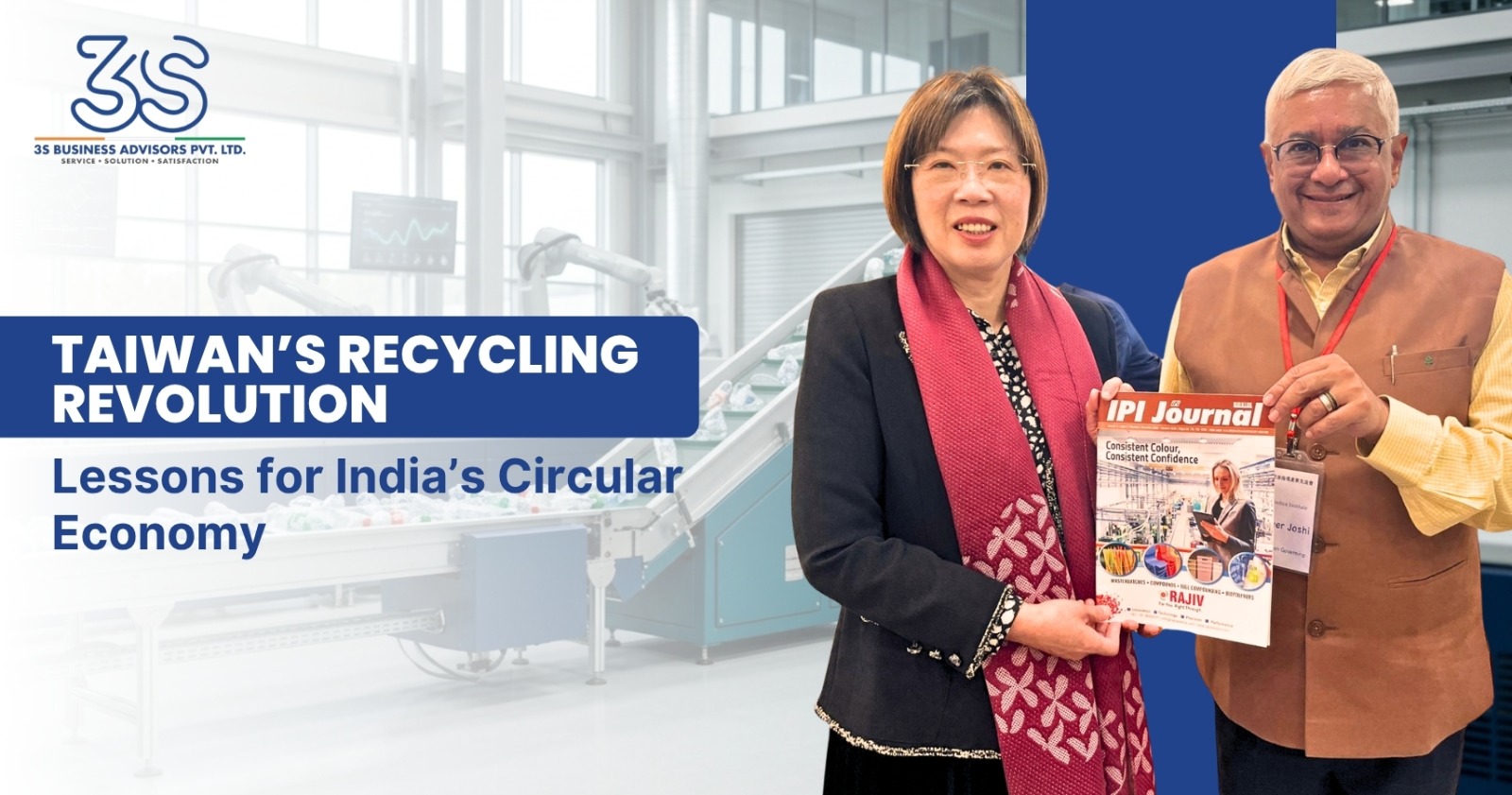
Taiwan’s transformation from a waste-challenged economy in the 1990s into a global recycling leader offers valuable lessons for India’s growing circular economy.
Since introducing the 4-in-1 Recycling Program in 1997, Taiwan has achieved recycling rates exceeding 50–60%. Its success is built on strong policy enforcement, industry participation, citizen engagement and disciplined execution.
In March 2026, an Indian industry delegation led by Dr. Sameer Joshi, with representatives from the Indian Plastics Institute (IPI), Material Recycling Association of India (MRAI) and other stakeholders, visited Taiwan from March 15–20. The programme included policy discussions, technology visits and business matchmaking, coordinated by 3S Business Advisors Pvt Ltd.
AI-Powered Recycling: Taiwan’s Smart Approach
One of the key examples was the New Taipei Recycling Education Base, an AI-powered smart recycling facility launched in 2023.
The facility uses four AI robotic arms to identify 17 types of recyclable materials with more than 97% accuracy. It can pick over 220 items per minute and process approximately 2,500 tonnes annually.
The system also uses real-time data analytics to monitor recycling activities and improve operational efficiency.
For India, AI, robotics and automation could help address the challenges of increasing waste volumes, sorting accuracy and labour-intensive recycling processes.
From Waste to Resource
Taiwan’s recycling ecosystem goes beyond conventional waste processing.
Pulian International Enterprise Co., Ltd., a Waste-to-Resource System Integrator, develops more than 100 types of machinery, including shredders, crushers and pulverizers.
Its solutions can convert plastic, agricultural and industrial waste into electricity, SRF/RDF and pyrolysis oil, while also supporting textile, e-waste and animal-waste treatment. The company has a global network covering more than 100 countries.
This approach demonstrates how waste can become a valuable industrial resource rather than simply an environmental burden.
Advanced rPET Recycling
Taiwan has also developed significant expertise in rPET recycling technology.
According to the report, BoReTech handles more than 5.8 million tonnes of PET recycling annually, representing more than 30% of global PET recycling. Its equipment has been exported to more than 40 countries, with over 260 major environmental engineering projects.
Its vertically integrated model covers R&D, production lines and rPET pellet manufacturing.
Digital Traceability and Standardized Recycling
Da Fon Environmental Technology Co., Ltd. operates 17 recycling service locations across Taiwan through its Five-Star Recycling Station model.
Its services cover collection, transportation, treatment and resource regeneration. Its B2B digital waste-traceability platform helps manage the waste lifecycle and improve transparency.
This highlights an important lesson for India: effective recycling requires traceability, standardization and accountability across the entire value chain.
What Can India Learn from Taiwan?
Taiwan’s experience provides several practical lessons for India:
- Strong policy implementation can create a stable recycling ecosystem.
- Industry participation is essential for scaling circular economy initiatives.
- AI and automation can improve sorting accuracy and productivity.
- Digital traceability can improve transparency and accountability.
- Waste-to-resource technologies can create economic value from waste.
- Skilled human oversight remains essential even in highly automated facilities.
- Standardized processes can improve long-term operational performance.
The study visit also highlighted Taiwan’s strong work culture, including transparency, communication, clearly defined responsibilities, quality assurance and continuous improvement.
India–Taiwan: An Opportunity for Circular Economy Collaboration
India's large market and growing recycling infrastructure, combined with Taiwan's technological expertise, create significant potential for collaboration.
Potential areas include:
- Recycling machinery
- Smart recycling technologies
- Technology transfer
- Joint ventures
- Recycling plant development
- Waste-to-resource systems
- Knowledge exchange
The March 2026 study visit resulted in an MoU between the Indian Plastics Institute and Taiwan's Resource Circulation Industry Booster Association, opening opportunities for recycling machinery deployment, joint ventures and knowledge exchange.
The Road Ahead
Taiwan's experience shows that building a circular economy is not only about adopting advanced technology. It requires strong policies, industry participation, efficient processes, skilled people and a culture of accountability.
For India, the opportunity is to adapt these lessons to its own scale and requirements.
With India's market scale and Taiwan's technological expertise, greater collaboration could accelerate innovation and investment in recycling and resource circularity.
Conclusion
Taiwan has demonstrated how coordinated policy, technology, industry participation and operational discipline can transform waste management into a modern circular economy.
For India, this journey offers both lessons and opportunities—particularly in AI-powered recycling, plastic recovery, waste-to-resource technology and international technology partnerships.
The future of recycling is not simply about managing waste. It is about turning waste into resources and creating sustainable industrial value.